Showing posts with label IRCA approved lead auditor course in India. Show all posts

Wednesday, 10 February 2016

ISO 9001

Quality has various definitions and has acquired a mystifying reputation for such. Indeed, the term "quality" is often used in an indistinct manner. The term has almost always been defined in the perspective of the manufacturing industry. In it, quality is the gauge or state of excellence or being free of defects, accomplished through firm and consistent observance to standards to attain consistency that satisfies customer or user requirements.

There has always been numerous confusion about what quality actually means, with individuals saying one product has a superior quality than another. This is perhaps because when people speak of the quality of a product or service, they generally refer to its excellence, perfection, or value. In reality, of course, quality should be defined in terms of how much the product or service meet ups its designed purpose and assures its original requirements.


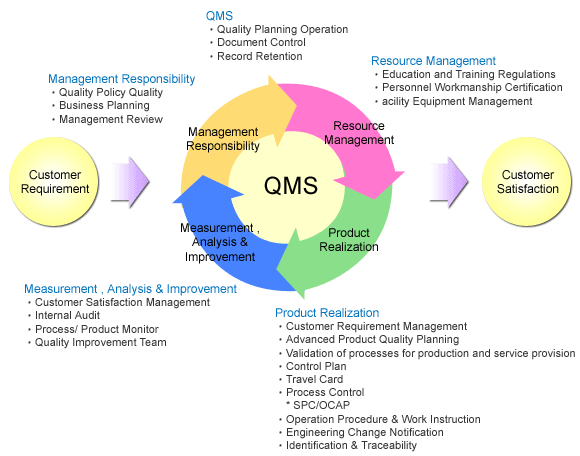
An organization controls its business operations through a quality management system which, if implemented properly, will lead products and services of a predestined quality to an ISO certification 9001. Quality Management System (QMS) is the arrangement of responsibilities, methods, activities, resources, processes, and events that together provide course of actions of quality implementation to make sure that the organization is proficient to meet quality requirements.

What are the requirements of a Quality Management System and ISO 9001 registration? To be unbeaten, organizations must be able to provide products that gratify customer requirements while meet the terms with relevant standards. Primarily, organizations must be able to endow with confirmation of quality product claims. How can anyone supply this proof? The easiest and most broadly recognized is to conform to the quality requirements of ISO 9001:2008.

There are, of course, expenditures and advantages of having a Quality Management System with an ISO certification 9001. In some Organization, a QMS can be very exclusive to establish, particularly if inadequate quality control processes were in the past used. However, this large spending must always be weighed against the savings in material, revise, and general problems that occurs from the lack of quality. Producing quality products is always followed by a lessening in administrative, operational, and production costs.


Monday, 1 February 2016

ISO 9001:2008 Certification Process & IRCA approved Lead Auditor Training

These days, acquirement of ISO 9001 certification will definitely improve an organization's business reputation. The ISO 9001:2008 standard involves the implementation of a documented quality management system to assist enhanced performance and competence.

ISO 9001 certification is proposed for any organization apart from of size, type or product including service. According to the ISO 9001 standard there a number of system requirements which an organisation needs to fulfill consecutively meet customer, regulatory and statutory requirements. Ensuring customer contentment through the quality management system is a key aim of the standard. The ISO 9001 standard also comprises elements that require observing and measurement of processes and persistent enhancement.

In order to accomplish certification an organization should have a recognized quality management system and not a system of documents. The three foremost purposes of the documentation should be for communication of in sequence, evidence of compliance and knowledge sharing. Quality management system documentation may be in any type such as paper, electronic or picture. An acquiescent QMS will need to address key aspects of the standard. There are 5 sections that outline the requirements of a compliant system, section 4 Quality Management System, section 5 Management dependability, section 6 Resource Management, section 7 Product comprehension and section 8 Measurement Analysis.

ISO 9001 section 4 requires that an organization has a documented system with process in place to control documents and records. Section 5 requires the QMS to comprise a quality policy and for senior management to reveal management commitment, assign responsibility and authority, and accomplish management reviews

Section 6 of the standard requires your system to address and review requirements for resources, human resources and training, infrastructure and work environment. Section 7 of the standard defines the requirements for planning, design and development, purchasing, production, organize of customer property and monitoring and dimension. Section 8 defines the quality management system commitments for measurement, monitoring and enhancement and includes sub-clauses internal audit, control of non-conforming product, curative action and precautionary action, all of which are obligatory procedures as defined by the standard.

ISO 9001:2008 refers purposely to only 6 documented procedures; however, other documentation may be requisite by an organisation in order to control the processes that are essential for the efficient procedure of the Quality management system. In addition to the least document prerequisites the standard defines twenty one precise requirements for records.

There are numerous requirements of ISO 9001:2008 where assessment can be added to a QMS by the grounding of other documents to reveal conformity such as process flow charts, process descriptions, organization charts, specifications, work instructions, accepted supplier lists and inspection plans.

The documentation required in a system to attain ISO 9001 certification is no longer as time-consuming as preceding to 2000 and the value of ISO 9001 certification for an organisation has certainly not been higher. Certification sends a comprehensible message to all concerned parties that an organization is devoted to high standards and persistent improvement.

IRCA approved lead auditor courses training program


The ISO 9001 lead auditor training program is based on the simple PDCA cycle principle. Scheduling the quality obligations to produce outputs which will support to ISO 9001 certification is the first step of the training. With a plan in place, performing day-to-day activities becomes simple.

IRCA approved Lead Auditor course in India is designed on speed up learning techniques and thus is highly appealing in nature. All participants of the lead auditor training courses have to go through 2 hours of examination. In addition, all participant of irca approved courses training program has to pass continuous tutor assessment to qualify to be entitled for participation in final exam.

Thursday, 21 January 2016

Characteristics of Quality Management System

Quality management systems can become unwieldy and bureaucratic if not accurately developed, implemented and maintained. Efficient quality management systems have ten common characteristics, these common denominators of quality management, when accurately implemented, can improve your business organization's ability to satisfy your customer and manage your processes and products more successfully. These ten common denominators are significant and applicable for organizations looking for ISO 9001, AS 9100 registration.

1.       A process is in position to ensure the requirements and expectations of customers and other concerned parties are evidently defined.


2.       The quality policy and quality purposes are defined, organized throughout the organization and understood by employees at all stages.

3.       Progression are documented in straightforward to use procedures that are up to date and controlled while responsibilities of staff are established and followed up on to accomplish objectives.

4.       Resources to come together with objectives are acknowledged and provided. Resources include people, processes, equipment and infrastructure.

5.       Metrics are time-honored and scrutinized for each process. The old axiom, "If it is not worth measuring, it is not worth doing," is certainly true for business processes. When a progression is not monitored and measured, how can leaders know if it is producing the preferred results? Many organizations are unsuccessful to set up criteria for monitoring and measuring processes and as a result incompetence is uncontrolled and it is very complicated to implement counteractive actions that actually work.


6.       Management is dedicated to using the metrics for process enhancements and for communications within the organization in addition to for holding people accountable for their performance. Liability is dependent upon two factors: 1) the people know what is projected and 2), the leaders follow-up to assure people do what is expected.

7.       A process is in position for preventing non-conforming product or services and in the occasion non-conforming the circumstances is documented and counteractive actions taken. In the case of non-conforming product, the process endow with for identification and isolation to prevent it from getting to a customer.

8.       Persistent improvement is a main concern and straightforward approaches are implemented to engage people throughout the organization in identifying frequent improvement opportunities.

9.       A structure for confirmation of processes and products is in place and execution as planned. This includes internal audits of the processes as well as product quality verification at diverse stages of production.

10.   Management is involved in the system and evaluations the entire system at suitable intervals to assure the system is carrying out as planned, is efficient for the business.

Quality management system built on ten introductory principles mentioned above give your business competitive benefits.
The Business organization can also train their employees to become a trained and certified Lead Auditor by irca approved courses training course like ISO 9001 Lead Auditor Courses that many consulting firms are offering today. IRCA approved lead auditor course in India will train and instruct an employee to carry out the internal inspections or the external checks of their company effectively. Hence by undertaking lead auditor courses training programs employees will develop a sense of inspections and will be able to effectively plan and conduct an inspection by identifying all the nonconformities on time in the company operations.


Thursday, 19 November 2015

5 Days QMS lead auditor programme in Delhi

5 Days Interactive QMS lead auditor programme in Delhi

Objectives of Course –

Our QMS Lead Auditor course designed for professionals who involved in auditing or responsibility to manage establishes, implement and maintain quality management system. This course is also beneficial for those who want to pursue there career in auditing, Quality Managers, Quality Assurance & Quality Control Engineer.


         IRCA approved lead auditor courses
Course Content -

QMS Auditor/Lead Auditor Training - IRCA approved (A17552).

The course is outlined to provide delegates with the knowledge and skills needed to audit and quality management system. QMS lead auditor training comprises of lectures and workshops including role play and case studies which develop full understanding of quality audit process and the practical sessions focus on audit process for QMS Documentation (Stage 1) as per ISO 19011 and ISO 17021

Course Introduction –

Eight Major Quality Principles
ISO 9001:2008 Standard Overview
Requirement of ISO 9001:2008
Workshop Conformity Assessment
Introduction to audit-Process Approach Audit
Audit plans & preparation
Auditor skills and techniques for process auditing
Onsite Simulated Certification Audit (Stage 2) as per ISO 19011 and ISO 17021
Certification and Accreditation process
IRCA registration Process
Written Examination

Course Fee - Just 18000 + Taxes

Course Duration -

IRCA approved lead auditor courses runs for five days running from 8.30 am until 7.00 pm for the first four days and from 8.30 am until 4.00 pm on the final day. QMS lead auditor courses training course may be run in-house for organizations wishing to train a team of auditors. Our courses are held at various locations in India, including Kolkata, Delhi, Chennai Bangalore & Kochi.

For further information contacts us

Mr. S. K Roy
L.22/11, Lower Ground Floor, DLF Phase II, Near Private Hospital, Gurgaon 122001, Haryana, India.
Phone: +91 98743 89139
Email: mbm@tr-cbl.com


Wednesday, 4 November 2015

What Is ISO 9001: 2008 Standard?


The recent edition of the ISO 9001 standard ISO 9001: 2008, Quality Management Systems Requirements, was officially published by (ISO) the International Organization for Standardization on November 14, 2008. It is the fourth edition of the ISO 9001 standard as it was first published in 1987.

ISO 9001:2008 is a standard that offers a generic set of requirements for organizations wishing to develop a quality management system (QMS). The ISO 9001:2008 standard focuses on developing organizations business processes. It does not indicate any requirements for product or service quality.  Customers typically set product and service quality requirements. However, the anticipation is that an organization with an effective ISO 9001 based QMS will indeed get better its ability to meet customer, legal and regulatory requirements.

This is the merely QMS standard to which an organization may perhaps obtain formal third party certification. Because requirements are generic and not specific, organizations have flexibility in tailoring their QMS to fit their business, ethnicity and hazards.

ISO 9001 requirements set off contractual and applicable statutory and regulatory requirements. Those implementing a QMS conforming to ISO 9001 must ensure that the explicit requirements of their customers and relevant statutory and regulatory agencies are met.

ISO 9001 lead auditor courses


Concepts of Quality Management System

ü  A Quality Management System in its fundamental concept is fairly simple. It seeks to: Recognize the external quality related requirements specified in Licenses to Trade, principles, particular customer requirements, and the preferred management system standard(s)
ü  Ensure that all rations have been documented within the management system in the appropriate location in requisites of defined explicit system requirements
ü  Confirm that employees receive appropriate training in the quality system requirements
ü  Outline performance processes, wherever applicable, to the quality system requirements
ü  Produce records or substantiation that system requirements have been met
ü  Measure, observe and report the level of observance with these performance procedures
ü  Continually monitor and analyze changes to the requirements and confirm that all changes are reflected in changes to the specific requirements when necessary
ü  Implement the audit and evaluate the system processes and correct them when required
ü  Comprise processes that will assist persistently improve the quality system.


Monday, 2 November 2015

How do I become lead auditor?

I often heard question from so many people how to become lead auditor? For this question I would like to suggest for lead auditor course training come with a certification exam. IRCA approved lead auditor courses help to perform ISO 9001 quality management system audits from different perception and also teach how to build an effective Quality Management System. ISO courses generally provided by accredited professional auditor and training organization, after completion of lead auditor training from IRCA approved lead auditor training in India from registered organizations, the applicant should learn about all the quality standards, quality control parameters, can evaluate quality management and can audit quality management in any organization.  By taking lead auditor training one will be able to develop practical perceptive of all the organizational issues, principles and practices and will be trained to evaluate the system precisely.
QMS Lead Auditor Course
QMS LEAD AUDITOR COURSE


ISO 9001 Lead Auditor Course creates a professional core within the organizations to impart all the inspectors about the modernized standards and requirements in the Business areas. The main objectives of this course are as follows:

* Identify appropriate organizational issues and demonstrate attentiveness concerning it among the employees.
* Identify suitable organizational aspects and legislation's.
* Understand the rationale of, and identify, suitable methods for eliminating risk factors.
* Infer the requirements of ISO 9001 in the context of an analysis.
* Plan and accomplish an Internal Audits in accordance with ISO 9001.
* Report the results and evaluation by writing valid, certain and value added non concurrence reports.

The foremost reason you should consider taking up ISO 9001 Lead Auditor Course is that it's the best lead auditor training in India that you can get to become proficient in auditing. There merely isn't any further type of ISO training that is widely available that provides such in depth coverage of the ISO subject matters. Also, the coverage to all the information, the prospect to discuss issues with experts and to interact with like-minded attendees with different experiences, ideas and situations will make your proficiency more accurate. You will also get thoughts to perk up your existing inspection quality and get more effectual results.

Some of the topics that are covered in this course are mention below:

* Quality concepts and their applications.
* Understanding ISO 9001:2008 standard and principles of quality.
* Quality system auditing & assessment process.
* Process planning and implementation.
* Methods and techniques to perform quality inspections, write non conformance's and corrective action requests, write precise reports and report them effectively.
* IRCA Registration Scheme.
* Product Liability and Product Safety Issues.
* ISO 9000 Certification.
* Carrying out various Exercises, Case Studies and Workshops.

The course pattern designed in
TCB Cert. Worldwide LLC is approved by IRCA UK. All those who oblige a pointed comprehension of Quality Management System Process and are in auditing process can get this training to give superior output is the concerned area. Also the workers who are responsible to carry out an assessment of suppliers and potential suppliers necessitate such training guidance. Apart from this it assists to improve the internal audits and get more effective results for business improvement. However, you will get efficient results only if you get the right level of training from a trusted ISO Standard company that has years of experience in carrying out such training programs regularly and delivering top quality auditors. Also, you must look whether they are providing you with a certification after successful completion of your course as it proves to be extremely beneficial for your career growth. 


Wednesday, 28 October 2015

IRCA Approved Lead Auditor Courses

Learning is always be a ongoing process even if you are a expert auditor, quality assurance team, quality analyst, top level management team then also sometime you feels that you have not learnt enough and that’s the reason everyone should try and adapt some new techniques and training as the more you learn more you grow in your stream.  If someone wants to become lead auditor for ISO 9001 then first step is to join IRCA certified lead auditor courses. In lead auditor training course, candidates is taught about ISO 9001 quality management systems audits and after completion of training you are able to perform audits against obligations of your organization and the requirements of ISO 9001. Lead auditor training and certification program ensures that you are able to perform audits, becomes expert in quality principles, audit preparation, reporting and follows up of audit.
There are different numbers of levels in which auditor aspires, and the most commonly are internal auditor and another is lead auditor. The process of internal audit is carried out by the organization with their team of internal auditors on quality system & sometime quality audit is proceeding by outside lead auditor consultant.  


ISO 9001 Lead Auditor Course Content Covered During Training

In IRCA approved lead auditor course the topics to be covered are given below:-

  • A brief review and overall rationale of quality management
  • Principle of quality management system
  • Interrelationship of the ISO 9001 standards (ISO 9000, ISO 9001, ISO 9004)
  • Roles and responsibilities of lead auditor or internal auditor
  • Audit planning and execution in accordance with the prerequisite of ISO 9001
  • Prepare audit reports based on the pre assessment visits
  • Prepare assessment checklist for audit reports.

IRCA approved lead auditor course in India is delivered as 5 days program which includes role plans, certification, accreditation process, it will also includes IRCA registration process and at last written examination that will usually conducted to check your knowledge what you gain during training program and auditing skills.

International Register of Certified Auditors

IRCA (International Register of Certified Auditors) was associated in 1984 by the quality assurance in the United Kingdom. Initially it was known as the Assessor Board, but later on in 1994 it was known as International Register of Certified Auditors and it is responsible for approving auditor training courses as well certifying auditors.